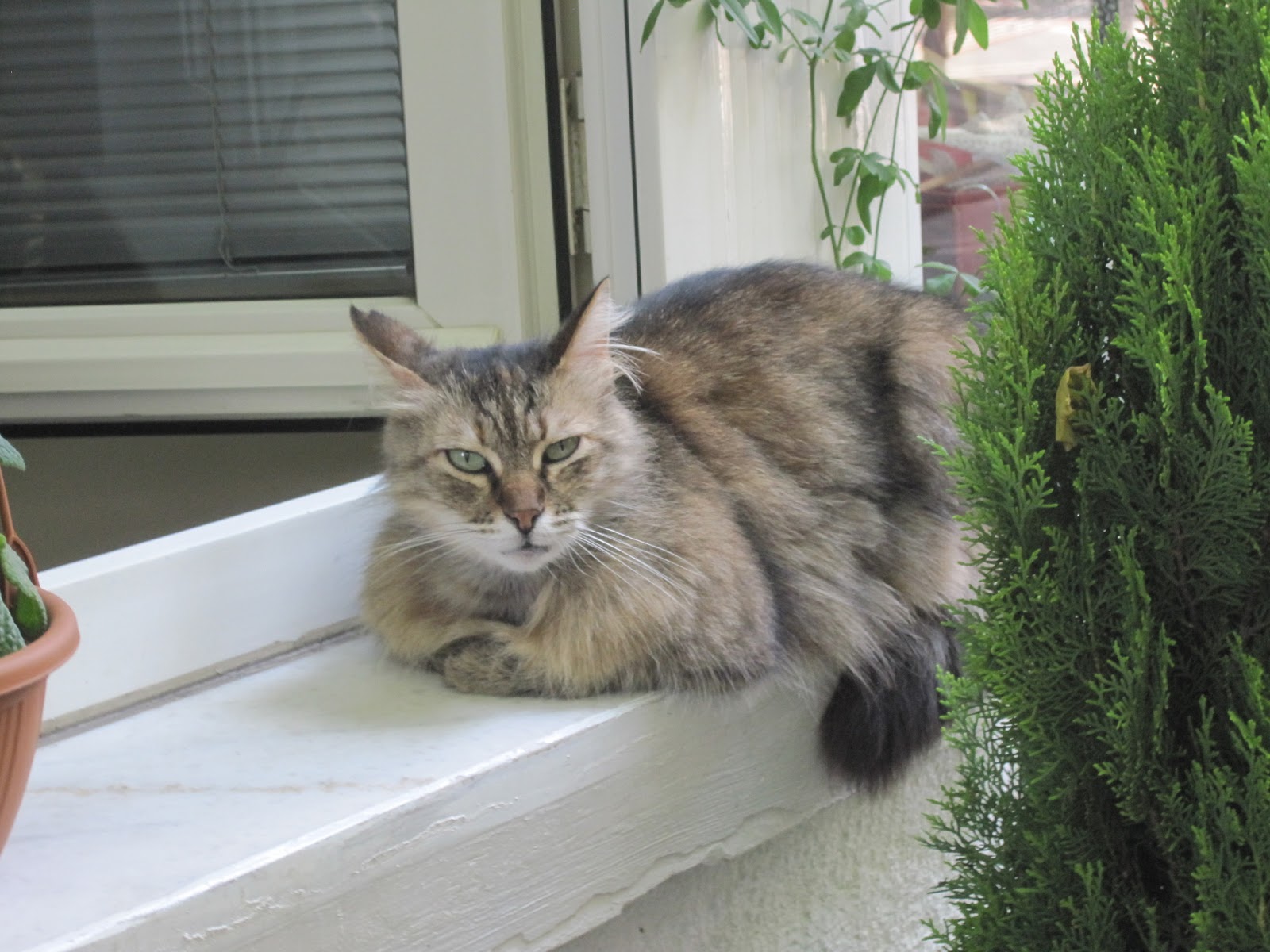
Couldn't help it - all the window displays have been changed!
Monday, 20 May 2013
Sunday, 19 May 2013
Felix catus finis
This is the last cat post I'm planning - they're everywhere!
Now I've managed to get up here by myself,
I'll just settle in and be comfortable.
Beware! Guard Cat!
Hmmm, is this where I put that tidbit?
If I can't see you, you can't see me.
Not all cats are black at night.
Mesh hammock.
This guy was patiently waiting at his door.
The cashpoint cat.
Felix finished. The last 10 images all from this afternoon.
Now I've managed to get up here by myself,
I'll just settle in and be comfortable.
Beware! Guard Cat!
Hmmm, is this where I put that tidbit?
If I can't see you, you can't see me.
Not all cats are black at night.
Mesh hammock.
This guy was patiently waiting at his door.
The cashpoint cat.
Felix finished. The last 10 images all from this afternoon.
Sunday afternoon in Kadıköy
A beautiful sunny day but the Spice Market/Mısır Çarşısı is closed so decide to go over to the Asya/Asia side to the neighbourhood called Kadıköy. This is one ferry stop away from Karaköy, my local stop. My goal is to locate those delicious preserved olives I ate at Çiya so many weeks ago.
Fortunately, Korhan is here and very kindly agrees to show me the sights of Kadıköy. We arrive on the Asia side, scope out the shop for the preserved olives and continue on to the walking/shopping street in this non-tourist area.
First off is a cookie break at a family run shop specializing in particular bakery goods. It had been threatened with eviction a few years ago but the local outrage was sufficient to garner it some kind of registered status so the family business will continue.
The shop window is full of so many varieties of pastries and sweets.
The treats here are two-fold: Tanhini Pide, a tahini biscuit
with sesame both inside and out;
and silver foil-wrapped Leblebi, a chickpea version of halva, best kept chilled.
All this walking leads Korhan to suggest a nice sit-down under some trees with a cuppa, so we head off to the Communist Party Cultural Centre. To get there we walk down this charming narrow street, lined on one side with tiny stalls of individual craft artists, and on the other with medical devices such as corsets, trusses, crutches, toilet seat extenders, foot and ankle braces - an extremely unpredictable combination.
On the way we pass a cafe serving only jacket potatoes with a broad range of toppings. Perhaps this is the origin of the dressed jacket potato? A Turkish tradition, this cooker on the pavement looks like it's been there a few decades.
The Cultural centre also projects films onto the large white wall in the back of this shot.
So very crowded, the only tables available in the shade are under a glass roof.
The building itself is an old and well maintained place, with bookshop and very clean loos.
Heading back to the ferry we stop to select and collect the preserved 'fruits' (technically an olive is a stone fruit, like a plum) but the colourful marzipan catches my eye as well.
Resplendent faux fruits are wasted on me, so after sampling the purest form I take 250 grams. This marzipan is probably 95% pure almond paste, with only a touch of sugar. The texture is delicate, soft, and not at all like the rock solid balls of chocolate covered hard centred Mozartballs. Reminds me of the first time I'd tasted home-made marzipan in Denmark so long ago.
Finally I focus on the preserved 'fruits' which are (L to R, top to bottom, skipping the puddings on the top shelf): individually gold foil wrapped whole chestnuts (marrons glaces), tomatoes, whole chestnuts loose, green olives, whole walnuts, peeled baby eggplants, unpeeled baby eggplant. Astonishing and beautiful.
Fully packed, wrapped and airplane-proofed, I am given the treats in this great little bag.
It's a good thing they are all so beautifully wrapped as otherwise I'd be sorely tempted!
Fortunately, Korhan is here and very kindly agrees to show me the sights of Kadıköy. We arrive on the Asia side, scope out the shop for the preserved olives and continue on to the walking/shopping street in this non-tourist area.
First off is a cookie break at a family run shop specializing in particular bakery goods. It had been threatened with eviction a few years ago but the local outrage was sufficient to garner it some kind of registered status so the family business will continue.
The shop window is full of so many varieties of pastries and sweets.
The treats here are two-fold: Tanhini Pide, a tahini biscuit
with sesame both inside and out;
All this walking leads Korhan to suggest a nice sit-down under some trees with a cuppa, so we head off to the Communist Party Cultural Centre. To get there we walk down this charming narrow street, lined on one side with tiny stalls of individual craft artists, and on the other with medical devices such as corsets, trusses, crutches, toilet seat extenders, foot and ankle braces - an extremely unpredictable combination.
On the way we pass a cafe serving only jacket potatoes with a broad range of toppings. Perhaps this is the origin of the dressed jacket potato? A Turkish tradition, this cooker on the pavement looks like it's been there a few decades.
The Cultural centre also projects films onto the large white wall in the back of this shot.
So very crowded, the only tables available in the shade are under a glass roof.
The building itself is an old and well maintained place, with bookshop and very clean loos.
Heading back to the ferry we stop to select and collect the preserved 'fruits' (technically an olive is a stone fruit, like a plum) but the colourful marzipan catches my eye as well.
Resplendent faux fruits are wasted on me, so after sampling the purest form I take 250 grams. This marzipan is probably 95% pure almond paste, with only a touch of sugar. The texture is delicate, soft, and not at all like the rock solid balls of chocolate covered hard centred Mozartballs. Reminds me of the first time I'd tasted home-made marzipan in Denmark so long ago.
Finally I focus on the preserved 'fruits' which are (L to R, top to bottom, skipping the puddings on the top shelf): individually gold foil wrapped whole chestnuts (marrons glaces), tomatoes, whole chestnuts loose, green olives, whole walnuts, peeled baby eggplants, unpeeled baby eggplant. Astonishing and beautiful.
Fully packed, wrapped and airplane-proofed, I am given the treats in this great little bag.
It's a good thing they are all so beautifully wrapped as otherwise I'd be sorely tempted!
Saturday, 18 May 2013
Ayasofya/Hagia Sofia
is massive but no need for me to reiterate that.
Wandering around the ground floor, most of my images were shaky as the light levels were so low, partially due to the internal scaffolding up for restoration:
But I was able to see a few things. This square support shows the decorative effects of a Black Sea bas relief of dolphins carved in black stone surmounted by a band of Egyptian porphryr, and supported by a band of Thessalonian green marble.
The Imperial Gate, so very tall and so very thick;
the ring handle is wider than my palm.
Next to the minbar (pulpit) inside the main space is one of a pair of 16th c early Ottoman decorative tiles depicting the Holy Ka'aba and the tomb of the Prophet. The squared-off crenelation theme repeats throughout the building.
An internal stone ramp of many switch-backs leads to the upper Gallery, where there is much more light.
From here the domes and column capitals are readily visible.
For scale, the calligraphic roundel is 7+m diam (23-24') and you can just make out the heads and shoulders of other visitors leaning over the railings on the opposite side. The floating figure in the triangular section beneath the windows ringing the main dome's base is a hexapterygon,
or six-winged angel. It seems that only two wings are required for flying, the others are for modesty (covering face and body), although the upper pair looks like an elaborate feathery turban to me .
On the way to the Empress's Gallery the mid-12th c Deësis mosaic,
faces the Marble Door, a reverse of the norm where wood imitates stone. Note the slope of the floor.
While the exterior architectural structure is again a composition of massed forms (Blue Mosque), the interior is a composition of layered arcs, arches with depth of space stretching out beyond.
And ancient carved graffiti:
On the way out, a final gallery on the ground floor with simple mosaic crosses.
Outside, the combined weight of all the domes is supported by these 16th c flying buttresses added by Mimar Sinan
at the base of which a tiny grassed area blooms with chamomile and potted cardinal flowers,
overlooking the excavated remnants of Theodosius II's Lamb of God frieze, originally adorning the Second Church of about 415 CE.
I found the cracked marble paving slabs very moving; so much time, so much wear from so many feet. During its time as a mosque, these slabs were covered with carpet, and only revealed after centuries when the building was converted to a museum in the 1930's.
This will marry nicely with my video and works on butcher paper for the exhibition.
Wandering around the ground floor, most of my images were shaky as the light levels were so low, partially due to the internal scaffolding up for restoration:
But I was able to see a few things. This square support shows the decorative effects of a Black Sea bas relief of dolphins carved in black stone surmounted by a band of Egyptian porphryr, and supported by a band of Thessalonian green marble.
The Imperial Gate, so very tall and so very thick;
the ring handle is wider than my palm.
Next to the minbar (pulpit) inside the main space is one of a pair of 16th c early Ottoman decorative tiles depicting the Holy Ka'aba and the tomb of the Prophet. The squared-off crenelation theme repeats throughout the building.
An internal stone ramp of many switch-backs leads to the upper Gallery, where there is much more light.
From here the domes and column capitals are readily visible.
For scale, the calligraphic roundel is 7+m diam (23-24') and you can just make out the heads and shoulders of other visitors leaning over the railings on the opposite side. The floating figure in the triangular section beneath the windows ringing the main dome's base is a hexapterygon,
or six-winged angel. It seems that only two wings are required for flying, the others are for modesty (covering face and body), although the upper pair looks like an elaborate feathery turban to me .
On the way to the Empress's Gallery the mid-12th c Deësis mosaic,
faces the Marble Door, a reverse of the norm where wood imitates stone. Note the slope of the floor.
While the exterior architectural structure is again a composition of massed forms (Blue Mosque), the interior is a composition of layered arcs, arches with depth of space stretching out beyond.
And ancient carved graffiti:
On the way out, a final gallery on the ground floor with simple mosaic crosses.
Outside, the combined weight of all the domes is supported by these 16th c flying buttresses added by Mimar Sinan
at the base of which a tiny grassed area blooms with chamomile and potted cardinal flowers,
overlooking the excavated remnants of Theodosius II's Lamb of God frieze, originally adorning the Second Church of about 415 CE.
I found the cracked marble paving slabs very moving; so much time, so much wear from so many feet. During its time as a mosque, these slabs were covered with carpet, and only revealed after centuries when the building was converted to a museum in the 1930's.
This will marry nicely with my video and works on butcher paper for the exhibition.
Subscribe to:
Posts (Atom)